Category: Groundfish

  • Simon Gorgin

    PayPal imposes set fees on deposits and withdrawals at online casinos. These charges come from PayPal’s own transaction processing structure, not the casino operator. Standard withdrawal fees apply for moving funds from a casino account back to a PayPal wallet. Casino slot games with single expanding reels that **feature buy bonuses** create intense competition for Bitcoin casinos. Players purchase direct access to these high-volatility bonus rounds at a set price. This model mimics Crypto gaming mechanics where speed and direct action are core player benefits.

    Fees And Limits Applied To Paypal At A Casino

    A PayPal deposit at an online casino typically incurs a percentage-based fee. Casinos often pass on this cost, though some absorb it to attract users. Daily, weekly, and monthly limits restrict transaction volumes. Limits protect both the user and the payment processor from fraud. High-limit PayPal accounts grant players greater financial flexibility. Gamblers should always verify their account tier before initiating large casino transfers.

    32Red Casino No Deposit Bonus Codes For Free Spins 2026

    No deposit bonus codes for platforms like 32Red Casino offer risk-free gameplay. These promotions provide free spins without requiring an initial cash deposit. Players gain immediate access to selected slot titles. The bonus game stands as the most captivating segment of any slot machine. This feature delivers entertainment and significant winning potential. Top-tier online casinos boast high payout percentages that attract gamblers yearly. Reliable operators publish their return-to-player audit reports for transparency. Reputable sites ensure promotions have clear wagering requirements attached.

    HANDMADE JEWELLERY

    AG Comm Casino processes withdrawals only after players meet all attached wagering conditions. These terms include playthrough rules on bonus funds. Players from New Zealand can enjoy classic table games like American Roulette. Winning strategies for casino games involve understanding house edges and optimal bets. Kiwi players seek casinos with fast payout speeds and local currency support. Legal frameworks in New Zealand permit international online casino play. Gamers should check licensing credentials before depositing funds. High RTP slots and low-edge Blackjack variants maximise player returns over time.

  • Best Non Gamstop Casinos United Kingdom

    Online Casinos UK Accepting Bitcoin Withdrawals

    Many online casinos in the UK now embrace Bitcoin withdrawals, making transactions swift and secure. Compatibility with devices like iPhones ensures that players can manage their funds conveniently on the go. Operators like Blueprint Gaming are pioneering this integration, offering seamless mobile experiences that cater to tech-savvy gamblers looking for efficiency in online play.

    This move not only caters to tech enthusiasts but also aligns with global trends towards cryptocurrency. Secure, fast, and discreet, Bitcoin withdrawals enhance player satisfaction, providing a robust platform for managing winnings.

    Best Non Gamstop Casinos United Kingdom

    Bright colors and fun graphics enhance the user experience at the top non-Gamstop casinos. These platforms adjust their visual theme accordingly, making every game session visually stimulating and enjoyable. The upbeat atmosphere is designed to complement the vibrant game mechanics and immersive soundtracks, offering a holistic entertainment experience.

    Free Spins No Deposit UK Keep Winnings

    Choosing online slots that offer real money play without requiring a deposit is a lucrative opportunity for players. These games provide a chance to win big without initial investment. Pay attention to slots that boast high RTP (Return to Player) and low volatility, which can increase your chances of accumulating substantial winnings.

    Additionally, it is beneficial to look for slots that offer generous free spin bonuses. These can significantly boost your playing time and increase your chances of hitting a jackpot without risking additional funds.

    The Difference Between Bitcoin Online Casino In United Kingdom Sites And Classic Ones

    When comparing Bitcoin online casinos to traditional online casino platforms, the differences become clear. Bitcoin casinos, for example, typically offer faster withdrawal times and improved security protocols due to blockchain technology.

    Traditional casinos, on the other hand, might offer more varied payment options and could be under stricter regulation, like possessing a gambling license from UK authorities. Such licenses ensure compliance with local gambling laws but might restrict the pace of transactions.

    Both types of casinos try to attract players with enticing bonuses, though Bitcoin casinos often provide the additional security and anonymity associated with cryptocurrency transactions. Each offers unique advantages, making them attractive based on player priorities like quick access to winnings or diverse gaming options.

    In conclusion, while both platforms have their merits, your choice between a Bitcoin casino or a classic one should depend on your specific needs as a gambler, whether it’s speedy payouts, funding diversity, or gaming variety.

    Online Cash Slots

    Online cash slots, like Arabian Nights by NetEnt, remain a favorite among gamblers due to their engaging themes and potential for large payouts. For instance, Arabian Nights brings players into a world of mystique with its progressive jackpot mechanic, where the stakes get higher as more players join in.

    This slot is particularly known for the Diamond Vortex feature, which can multiply winnings exponentially, making it a hot spot for those looking to earn big. The blend of traditional gameplay with innovative features like these keeps players coming back for more.

    Live Blackjack Online UK

    Live Blackjack remains a staple in many UK casinos. This version of the classic game allows players to engage with real dealers in real-time streaming. Though it might be a less known setup compared to standard online blackjack, its authenticity brings you closer to the feel of being in a physical casino.

    This format allows for real-time decision-making and strategies that are more dynamic compared to the digital version. Players can interact not just with the dealer but also with fellow players, which adds a layer of social interaction missing from traditional online games.

    The platforms that offer live blackjack in the UK are equipped with advanced streaming technology, ensuring that the experience is smooth and immersive. High-definition visuals and sound guarantee that every dealt card and discussed strategy is clear and engaging.

    It’s essential to choose platforms that are known for fairness and transparency, allowing you to enjoy the game without concerns over integrity. Opt for casinos that utilize industry-standard gaming software and are audited by independent bodies.

  • Top Non Gamstop Gambling Sites For Uk Players

    Recent Posts

    Casinos not on gamstop represent alternatives for players seeking sites outside self-exclusion programs like gamstop which restrict access to regulated uk operators.

    These platforms provide opportunities to engage in betting activities without limitations often applied under local regulatory frameworks, appealing particularly to those excluded from mainstream operators.

    Such casinos often feature diverse game portfolios including slots, table games, live dealer options, and sports betting markets unavailable under gamstop guidelines.

    While they attract players wishing to bypass self-exclusion, users should evaluate carefully the reputability and licensing status of each individual site before participation.

    Recent Comments

    Players share mixed experiences regarding casinos outside gamstop with some commending broader game availability while others caution about varying withdrawal times and customer service quality.

    Comments often highlight how non gamstop sites appeal due to higher deposit limits or absence of strict spending caps found in uk-licensed establishments.

    Some users discuss strategies for finding sites offering lucrative bonuses and promotions as incentives to join and sustain engagement.

    Common concerns mentioned in recent discussions include potential lack of responsible gaming measures compared to regulated operators under gamstop.

    Archives

    Archived content provides insights into how non gamstop gambling platforms adapt over time, adding innovative features or expanding their offerings to retain player interest.

    Earlier posts show a trend of increasing popularity among uk players looking for unrestricted access to gambling services unimpeded by domestic self-exclusion schemes.

    Content in older archives may reference now-defunct sites, illustrating the dynamic nature of this market with newer entrants constantly replacing older platforms.

    Categories

    Categories group non gamstop sites by type such as casino-focused platforms, sportsbooks, or hybrid options providing both forms of entertainment.

    Specific subcategories can detail sites with exclusive live dealer games, crypto-friendly payment systems, or mobile-optimized interfaces aimed at user convenience.

    Thematic keys like **gambling sites**, **self-exclusion**, **betting activities**, **game portfolios**, **reputability**, and **responsible gaming** frame this discussion around accessible alternatives for **uk players** engaging in **non gamstop gambling** options. These venues typically attract attention through tailored offers and **innovative features** that cater to a specific audience, though users must weigh **licensing status** and **customer service quality** in their choices.

  • West Coast Pilot – Culinary Workshop

    West Coast Pilot – Culinary Workshop

    A previous post outlined our pilot project in California with Changing Tastes; this post provides a peek into a culinary workshop that is part of the planning phase.

    Purpose

    As part of our work to reintroduce local fish back into local markets in California, our foremost consideration is how to reintroduce them to our plates and palates. Without delicious dishes and high quality products, winning back a space on the plate will be impossible.

    To discover how local fish can create a winning combination of flavor, presentation, and affordability for chefs in corporate dining, our partner Changing Tastes arranged a culinary workshop in California. More than a dozen chefs and several sustainability managers from the same or similar groups joined us in mid-November at a test kitchen in the Bay Area to develop the recipes and messaging needed to successfully bring back Californian West Coast Groundfish.

    Palate and Pocket

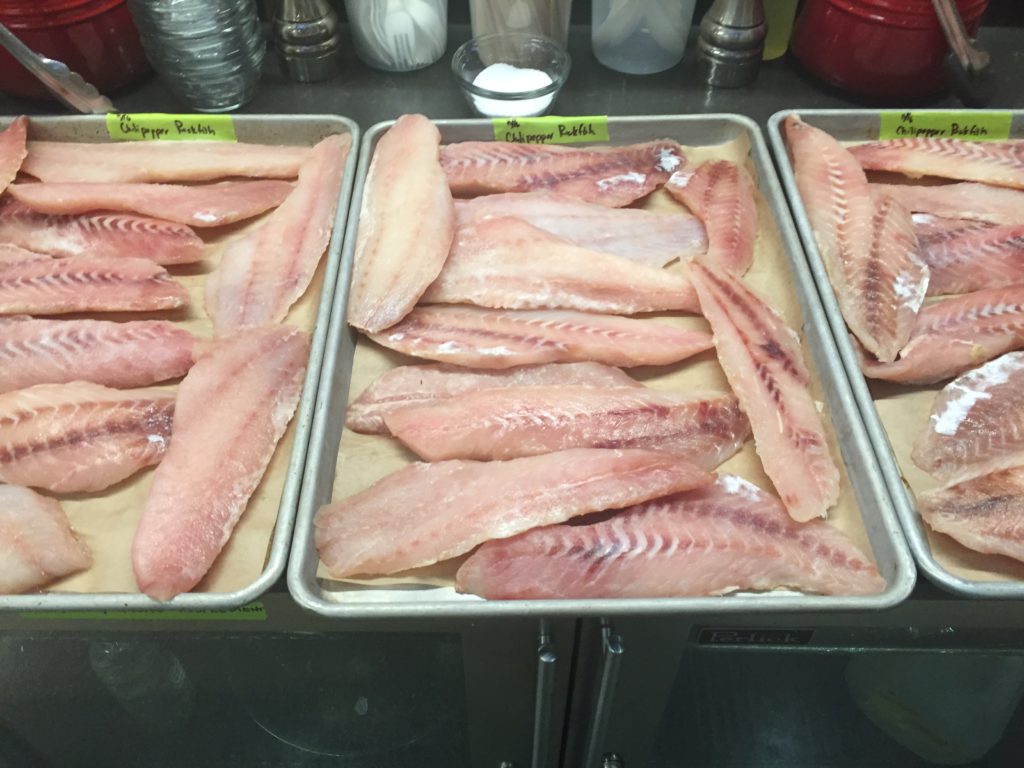
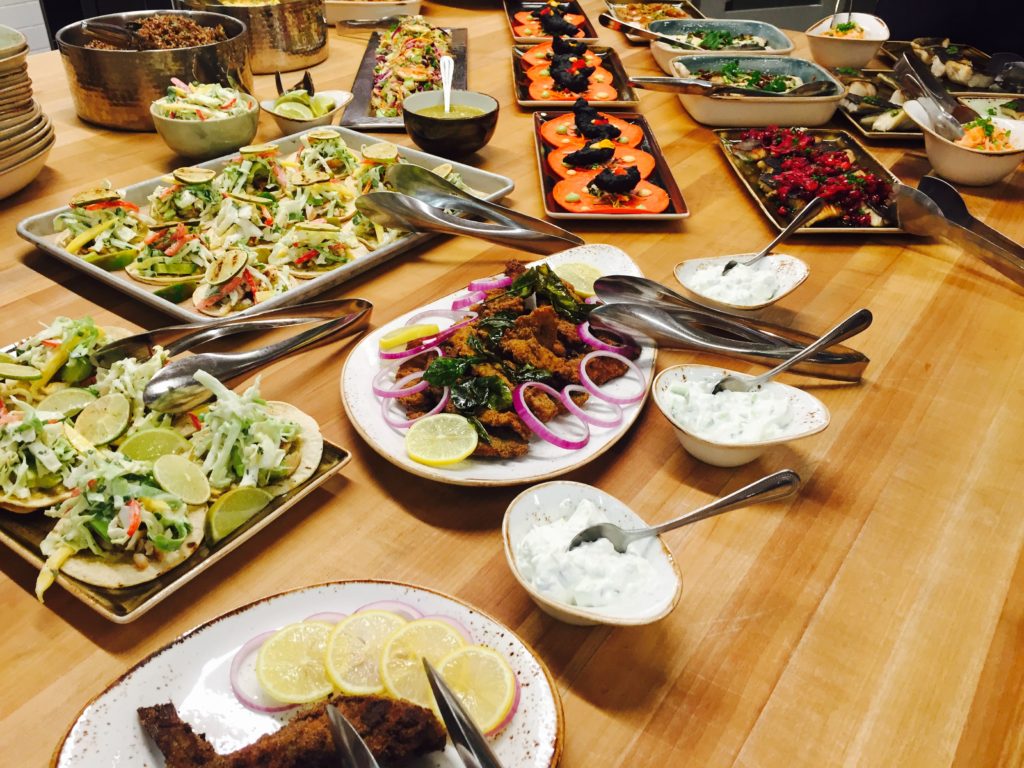
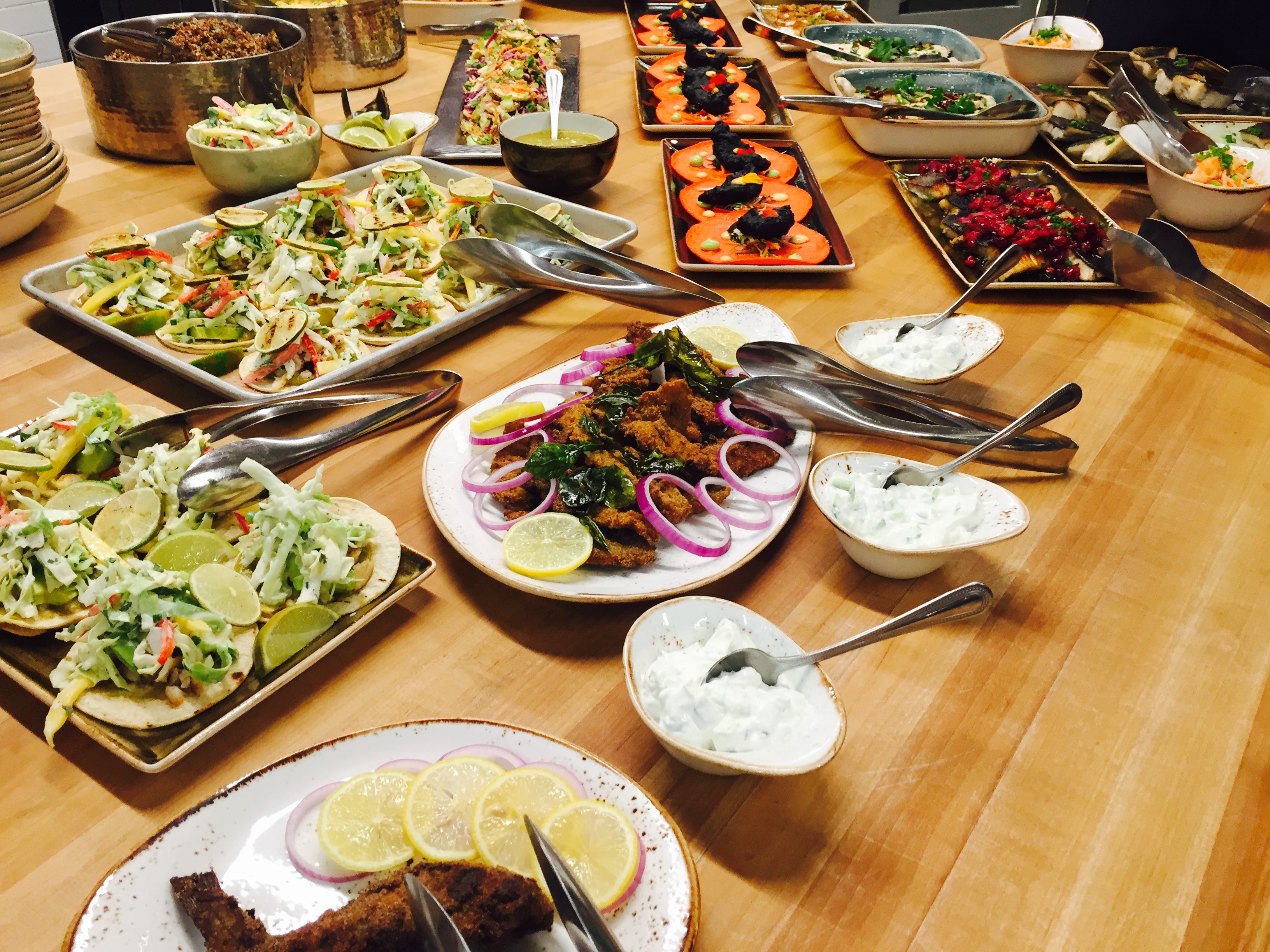
    To explore which fish could please both palates and pocketbooks, the chefs spent the morning preparing a sampling of locally-caught fish, including Dover and petrale sole, boccaccio, chilipepper and black gill rockfish, and sablefish (AKA black cod) provided by Real Good Fish. These fish represent the spectrum of species that are part of the West Coast Groundfish program, one of the most sustainably managed fisheries in the world, and one that has the fish to prove the stocks are  healthy. These are fairly common landings that span from very inexpensive Dover to higher-end sablefish. The variety of textures, thicknesses and tastes were highlighted in Latin and Asian-inspired themes, such as black gill fish tacos with mango slaw (Chef Ochoa), petrale-coconut ceviche (Chef Fogata), black and white coconut crusted black cod (Chef Thomas), and steamed Szechuan boccaccio (Chef Hernaez).

    Heart and Mind

    Equally important to taste and cost is persuading diners to try these new dishes. In a nearby space, restaurant industry marketing and communications executives as well as sustainability managers and representatives of groups that support sustainable seafood brainstormed marketing ideas for the dining spaces where the fish will be offered to diners next spring.

    Common themes included emphasizing that the fish is locally-caught in California. They noted that “local” often implies fresh to diners. Including a map of the different ports where the fish originates from for the pilot, and identifying fishermen and women from each was another popular theme.

    Marketing experts, chefs, sustainability managers and others agree on not using the word “groundfish” in marketing materials. This group and others realize that this collective term for these species isn’t one that necessarily appeals to diners, nor does it help them understand the diversity of species and flavors within the broad category.

    Pilot Evaluation

    Among potential evaluation methods and data points, our participants identified these as the most likely:

    • On-site, established food focus groups
    • Measurement of orders by volume
    • Gauging the relationship between price of dishes and purchases
    • Comparison to sales of other seafood dishes
    • Comment cards
    • Online commenting system
    • Surveys, potentially with incentives, and/or provided in a quick format via touchpad at the point of purchase
    • Querying the culinary team during and after the pilot


    Post-workshop steps

    Our next tasks are confirming which specific dining halls and cafes will participate from each of the corporate dining partners and confirming likely order volume by species or species group, e.g., petrale sole is a species and rockfish is a species group. Almost simultaneously, we will work with the corporate dining partner and their existing distributors to determine the likely sources, feasible start dates, and volumes. We look forward to sharing updates as this work progresses in 2018.


  • West Coast Groundfish Pilot: What’s Next for Developing Local Markets?

    West Coast Groundfish Pilot: What’s Next for Developing Local Markets?

    A previous post outlined the results of the recent market demand research for West Coast groundfish. This post follows-up with more detail on the proposed West Coast groundfish pilot.

    Purpose and Intent

    And now what? That was our first question after learning the results from the market demand research. Those results indicated that next efforts to improve demand and pricing for West Coast groundfish should focus on selling minimally processed products to suppliers and buyers in the grocery retail and full service restaurant sectors. The answer is a pilot project; one designed to test the findings which will help U.S. West Coast fishermen expand into regional market.

    This project would aim to raise commercial buyers’ and suppliers’ awareness of U.S. West Coast Groundfish as a domestic, sustainable source of whitefish and prove that these fisheries can provide a reliable supply of local fish. As a result, it will establish new markets and demonstrate the benefits and availability of West Coast groundfish to other buyers and suppliers.

    Rationale

    A pilot project, with defined sales periods and goals, will provide room to experiment to build relationships and to understand the market dynamics. Without a pilot, it will be difficult, if not impossible, to rally collaborative action or justify further investments in the fishery. Harvesters and buyers envision a pilot as being a first step in creating an ongoing sales effort that expands beyond the West Coast within two to three years, possibly sooner.

    A successful pilot is key to having larger, sophisticated customers purchase significant quantities for a substantial part of their operations; the pilot also develops the tools they need to successfully use and continue purchasing the fish. Assuming the pilot results in positive values, harvesters, trusts, buyers, NGO’s, and potential investors will have information necessary to make decisions about infrastructure, marketing and other investments. In addition, they can start sizing-up plans in the local, regional and national markets, all of which are important to increasing quota attainment.

    Framework

    To create organizational capacity that endures beyond the period of the pilot, it needs to be structured carefully. The fishermen and the buyers need to feel comfortable with their roles and build knowledge useful for future efforts. Because of this, the pilot project will endeavor to work within the existing supply chain to build the ability of the harvest groups and processors to provide reliable supply. Memorandums of understanding and contracts for the pilot have to be written so all the parties involved understand their roles and feel comfortable with their responsibilities. Of utmost importance, the pilot design must incorporate a way for the value chain to continue the work after the pilot concludes.

    Target Outcomes

    Some specific questions the pilot should be designed to answer revolve around the conditions and requirements for supply and pricing. At the outset, stakeholders will need to address legal restrictions on collaboration. The pilot should also define the incentives or conditions needed to gain cooperation between the processors and the groundfish harvesters. Also, the pilot should delineate the amount of fish, prices, and timing (flow of supply and seasons). Finally, the pilot will try to determine the level of transparency needed to build trust so that value chain actors can work together as a team to create value.

    Final Thoughts

    Regardless of who carries out the work, a pilot is the best next step for the West Coast groundfish stakeholders. The ultimate goals are easy – improve profits for those paying for management – but the route has to be carefully plotted. Building trust and knowledge and demonstrating improved values are key. We can get there, but we have to keep the focus on the end goal of a sustainable fishery, which means ensuring profitability for the harvesters.

  • Regional Demand and Opportunities for West Coast Groundfish

    Regional Demand and Opportunities for West Coast Groundfish

    Our latest project, West Coast Groundfish Regional Market Demand and Opportunities, explored the market demand for U.S. West Coast groundfish in Oregon, Washington, and California. This post is a brief summary of that work. For more, please check out the executive summary of the report.

    Background

    Faced with plummeting catch levels and fish populations near collapse, many fishing boats left the U.S. West Coast groundfish fishery in the 1990’s and 2000’s. Commercial seafood buyers on the West Coast then turned to other whitefish, including Asian tilapia and Alaskan pollock.

    Today, under new management systems, U.S. West Coast groundfish populations have rebounded and are fished sustainably – more than 20 species now rate as a “green, best choice” or “yellow, good alternative” with the Seafood Watch program, and 13 have received Marine Stewardship Council certification. With this conservation success in hand, how does U.S. West Coast groundfish regain a competitive market position and ensure that the recovery story includes economic success for fishermen?

    Several studies have looked at the production side of this question, outlining supply chain hurdles and infrastructure issues that keep fishermen from reaping higher prices. This study is the first to look at the demand side of the market: how much whitefish West Coast buyers purchase; what potential there is to sell sustainable, U.S. West Coast groundfish in these regional markets; and how fishermen can increase the price per pound that they receive for their fish.

    Methodology

    Through a combination of market analyses, buyer surveys, industry interviews, and expert review, Changing Tastes and Wilderness Markets examined the current demand for West Coast groundfish in Washington, Oregon, and California. We identified categories of commercial buyers (e.g., restaurants, retail grocery stores) and types of seafood products that hold the greatest potential to increase economic gain for fishermen. We also explored the key barriers that fishermen will need to overcome to sell more product in these markets.

    Results

    Our results shows that focusing on selling minimally processed products to grocery and full service restaurant sectors holds the greatest potential to improve sales and profits for U.S. West Coast groundfish fisheries. Consequently, the next logical step is to test these findings. To do so, and help U.S. West Coast fishermen expand into regional markets, we recommend the development and launch of a pilot project. This project would aim to raise commercial buyers’ and suppliers’ awareness of U.S. West Coast groundfish as a domestic, sustainable source of whitefish and prove that these fisheries can provide a reliable supply of local fish to West Coast markets. If successful, it will establish new markets and demonstrate the benefits and availability of West Coast groundfish to buyers and suppliers.

    We welcome your feedback on the market report and pilot concept. We hope that this research will stimulate additional conversations and partnerships that can help the U.S. West Coast groundfish fishery become a model of both ecological and economic success.

    Prepared with support from:
    The David and Lucile Packard Foundation and The Gordon and Betty Moore Foundation

    For more of our work with U.S. West Coast Groundfish, please see our previous report, “West Coast Groundfish in California Value Chain Assessment.” 

  • US West Coast Groundfish – Key Market Channels

    Continuing our market demand assessment work with US West Coast Groundfish, our partner, Changing Tastes completed an assessment of key distribution channels to prepare for the survey they’ve just initiated. In this post, we discuss what the key distribution channels are, their preferences for fresh and frozen, and why any of that matters.

    As we and others have said, the story of US West Coast Groundfish is one of best fish stories you probably haven’t heard. The fishery was declared an economic disaster in 2000, but in 2014 thirteen species were MSC certified in 2014, eight groundfish in the California Groundfish Collective fishery are green-rated by Seafood Watch plus more from the fishery that are green- or yellow-rated. In an effort to increase overall value in the fishery, we’re working with Changing Tastes to help determine who could be purchasing this fish and the key characteristics of demand.

    Changing Tastes recently initiated a survey to assess demand, but they had to identify key market channels in order to focus assessment efforts. The following information is based on their work, which they completed using a combination of methods, including:

    • Government data for whitefish consumption
    • Publicly and privately held company data
    • Professional opinion gained from working with some of the nation’s largest restaurant and food service companies and grocers

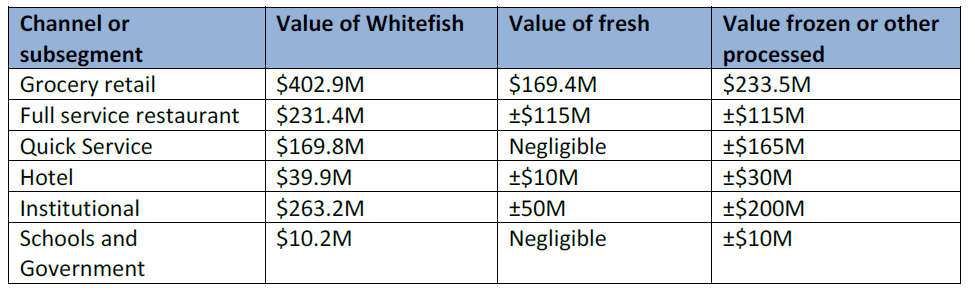
    Total sales of whitefish (a broad category that would include the species landed in the fishery) are estimated at US $542.9 million in the three West Coast states based on US government data, with $442.7 million of that spent in California. Total dollar value of whitefish was second to shrimp, unsurprisingly.


    Click to see table of approximate dollar values

    Sales and format value comparisons of whitefish in California, Oregon and Washington. Green is the proportion of the value sold fresh; blue is the proportion sold frozen. Size of the graph is relative to the total values of whitefish bought. (“School and government institutions” and “Hotels” are shown larger than their proportion of the total for visibility purposes. Grocery is actually ten times larger than hotel, and 40 times larger than schools and governments.)

    These channel categories are generalizations—different companies and brands within each category may use different mixes of fresh and frozen—but the generalizations are useful for determining which channels to concentrate on for survey completion.

    Interestingly, an unpublished May 2016 study by Globescan noted that California consumers are 20% more likely than the average national consumer to buy fish from fresh counters in grocery stores.

    Click to see table of approximate volumes
    Click to see table of approximate volumes

    Changing Tastes then screened the channels using their professional opinion on parameters based on the desired outcome of improved values, including their ability of a market channel to:

    • pay a premium for higher quality, local or sustainable
    • use whole or minimally processed fish, frozen or fresh
    • practice seasonality by varying menu options
    • be flexible with species offered

    Based on values, volumes and their professional opinion, Changing Tastes is prioritizing receiving feedback from the following channels, and the specialty distributors who supply them:

    1. grocery
    2. full service restaurants
    3. institutional foodservice sub-segment of colleges, corporate dining, and cultural and leisure destinations
    4. hotels

    The survey started landing in inboxes last week. By mid-October, we should have more to report about the initial findings. Until then, if you have questions, comments or suggestions, we’d love to hear from you.


  • What lessons can be learned from the Icelandic cod value chain?

    Iceland - Siglufirði Siglufjörður By Hansueli Krapf This file was uploaded with Commonist. [CC BY-SA 3.0 (http://creativecommons.org/licenses/by-sa/3.0)], via Wikimedia Commons

    Iceland – Siglufirði Siglufjörður By Hansueli Krapf This file was uploaded with Commonist. [CC BY-SA 3.0 (http://creativecommons.org/licenses/by-sa/3.0)], via Wikimedia Commons

    Icelandic cod first came to our attention at Wilderness Markets when we were collaborating with Future of Fish on research into financing needs in the US Northeast Multispecies Sector Program. How can cod from, Iceland, over 2000 miles away be not only cheaper but of equal or better quality than cod caught from just outside your proverbial front door?

    A series of papers highlights important developments and key factors in the success of the Icelandic cod value chain since the ‘90s. The series include:

    1. The Effects of Fisheries Management on the Icelandic Demersal Fish Value Chain, 2016[1]
    2. A Comparison of the Icelandic Cod Value Chain and the Yellow Fin Tuna Value Chain of Sri Lanka, 2010[2]
    3. The Role of Fish Markets in the Icelandic Value Chain of Cod, 2010[3]
    4. The Importance of SMEs in the Icelandic Fisheries Global Value Chain, July 2009[4]
    5. Structural Changes in the Icelandic Fisheries Sector – A Value Chain Analysis, 2008[5]

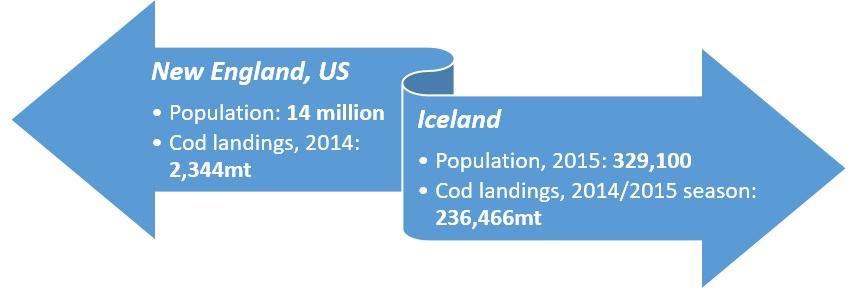
    Before digging in too far, two aspects of the Icelandic versus the New England value chains can’t be overlooked—the relatively small population of Iceland and the relatively high landings of cod.  For disputed reasons (climate change, better management, etc.) Iceland has a much healthier, i.e. more abundant stock, and hundred-fold greater landings than New England. Along with much higher landings, a far lower population means a robust export market.
    2016-06-23

    [6]

    Key factors and developments:

    • Increased efficiency at multiple levels of the value chain has helped improve value
    • Domestic value creation, specifically in the form of fresh fillets, has added significant value
    • Information flow (availability of information) and knowledge drive value
    • Use of marketing information to govern the value chain through vertical integrated companies and fish auction markets
    • Fish markets (auctions) improve efficiency and improve the consistency of supply for the value chain by acting as clearinghouses and support speculation
    • Consolidation of vessels, fishermen, processors, processing workers, and quota ownership have occurred in significant number
    • Increased specializations in fishing and processing

    An interesting aspect that warranted a whole paper is the role of the fish markets, effectively online auctions, wherein all bidding is done through one computerized system owned by 15 independent markets since 2000. These private markets only handle 20% of the landings by volume but have a high value in terms of value chain efficiency because they allow for specialization (buyers can sell or swap species not needed for production), provide stability (buyers can ‘top-up’ if they are short on supply) and creates market-driven value for species. The rise in general groundfish prices by 20% from 1999 to 2008 is thought to be partially attributed to the fish market system.

    Some key aspects of the Icelandic cod value chain, like low human population in Iceland and abundance of target species in their waters, don’t readily translate to Wilderness Markets’ recent focus on the Indonesian and U.S. West Coast fisheries. Others do. For instance, in the paper on the importance of small and medium enterprises (SMEs), the increase in vertically integrated companies means those companies have better control of the reliability, quality and delivery of fisheries products. Their competitive advantages are related to quality assurance knowledge, good logistics and dedicated export and sales management. On an almost reverse timeline for the U.S. West Coast groundfish fishery in California, fish handling in Iceland improved in the ‘90s and ‘00s by investments in better onboard cooling systems, shorter fishing trips and logistics improvements.

    In the 2016 paper, they also describe the structure of the value chain before the export licensing system was abolished in the 1980s—importantly, and with implications for other value chains – the three large marketing and sales organizations that controlled most of the fish failed to send market signals back to producers. The new, vertically integrated companies that replaced these organizations heeded signals from foreign customers and improved product quality and successfully added value domestically by switching processing to Iceland instead of overseas.

    We have witnessed this same disconnect in many other fisheries; fishermen don’t seem to have any idea about the needs and demands of the end markets and have no incentive to meet these demands. In one of the most telling statements in the series, an interviewee states, “They [the Norwegians] are still mostly thinking about catching while we have reached the point where we think about serving the market.” Most fishermen have not yet been able to reach this stage, hindering their ability to realize improved value for their work.

    We’re hopeful that the end-market research currently underway in California will provide market data that can be turned into increased value for the harvesters working diligently to promote sustainability.

    [1] Knútsson, Ö., Kristófersson, D. M., & Gestsson, H. (2016). The effects of fisheries management on the Icelandic demersal fish value chain. Marine Policy63, 172-179..

    [2] Knútsson, Ö., Gestsson, H., Klemensson, O., Thordarson, G., & Amaralal, L. (2010). A Comparison of the Icelandic Cod Value Chain and the Yellow Fin Tuna Value Chain in Sri Lanka.

    [3] Knútsson, Ö., Klemensson, Ó., & Gestsson, H. (2010). The Role of Fish-Markets in the Icelandic Value Chain of Cod.

    [4] Knútsson, Ö., Gestsson, H., & Klemensson, Ó. (2009, July). The importance of SMEs in the Icelandic fisheries global value chain. In IXX EAFE Conference Proceedings (pp. 6-9).

    [5] Knútsson, Ö., Klemensson, Ó., & Gestsson, H. (2008). Structural changes in the Icelandic fisheries sector-a value chain analysis.

    [6] New England Population: http://www.dlt.ri.gov/lmi/census/pop/neweng.htm
    Iceland Population: http://www.iceland.is/the-big-picture/quick-facts

    US landings: http://www.st.nmfs.noaa.gov/commercial-fisheries/commercial-landings/annual-landings/index
    Icelandic landings: http://icefishnews.com/wp-content/uploads/2013/05/Marko-partners-%C3%ADslenski-kv%C3%B3tinn.png
     

  • Groundfish Market Demand in California

    Groundfish Market Demand in California

    We’re pleased to announce that Changing Tastes and Wilderness markets will be collaborating to carry out the market research for groundfish in California announced in our RFP. Having robust data about business and institutional buyers close to the consumer will address one of the key information gaps we identified in our value chain analysis; the ultimate goal of the work is to improve the economic value of products from this fishery. 

    (more…)

  • Markets for Groundfish in California, Part 4 of 4

    This is part 4 of a 4-part series intended to invite conversations in advance of our planned end market demand analysis for groundfish in California. The larger goal is to provide quantified end market data to inform profitable value chain investments that will positively impact harvesters, local communities and the ocean.

    Waste and discards

    The opaquest parts of the value chain are the discard and waste streams; we don’t have volume figures to distinguish between discards and processing trimmings and how much of each goes to secondary processors or to landfills. We believe this to be important given the high level of biomass discarded – in some cases as much as 70% of the landed fish (e.g. Dover sole, which has one of the higher quotas).

    We identified one secondary processor and were told that disposing of processing byproducts is not a moneymaker; indeed, disposing of trimmings is a cost for processors which may be passed to harvesters. Just how much of a cost is unknown. Also unknown is what proportion is sent to the secondary processor and how much may be destined for landfill. In addition, we don’t know what volume of fish or fish waste enter this stream since the final end-market forms for domestic consumption is unknown (and thus how much fish is processed or sold whole is unknown).

    A potential local solution to unvalued fishery byproducts was initiated in Morro Bay in which local farmers picked up bins of fish parts and turned them into soil amendment. However, discovery of state regulations that limit processing of the fish parts prohibited the continuation or expansion of the program.[1]

    Questions: Would improving the value of discards and trimmings improve the value realized by harvesters? Is this a viable alternative market?

    Final Thoughts

    The West Coast Groundfish fishery could be a case study for successful fisheries management for hundreds of other fisheries around the world if it weren’t for the fact that so many harvesters still seem to be struggling economically. Until the harvesters are profitable enough to cover management costs, the most important part of the puzzle isn’t in place. Figuring out where the different pieces fit—value drivers, product flows and the like—will be a boon not only to these harvesters and their communities, but also to parties interested in investing in this, and other, fisheries.

    [1] Kathy Johnston, “Hook, Line, and Sinker,” New Times, December 7, 2011, Volume 26, Issue 19 edition, http://www.newtimesslo.com/news/7042/hook-line-and-sinker/.